If you’ve typed “sunflower oil supplier Thailand” into a search bar, you’re probably past the stage of wondering whether sunflower oil is a good product to source and you’re now trying to work out who to actually buy it from. That’s a different problem, and it’s a harder one, because a website with nice photos and a contact form doesn’t tell you much about whether the company behind it actually processes oil, holds the right export licenses, or will still be answering emails after your deposit clears.
We’re DThai Company Limited. We process and export sunflower oil out of Thailand, in bulk and packaged formats, and this piece is written for the part of the search that comes after “where do I find a sunflower oil supplier Thailand”, the part where you’re trying to figure out who’s real, what paperwork to ask for, and how shipping actually works out of a Thai port.
Table of Contents
Why Buyers Are Searching for a Sunflower Oil Supplier Thailand Right Now
Sunflower oil sourcing has gotten more complicated over the past several years, mostly because Ukraine and Russia together used to account for a huge share of world sunflower oil exports, and that supply got disrupted. Buyers who used to source almost automatically from the Black Sea region started looking elsewhere, and Thailand’s position as a processing and export hub in Southeast Asia made it a natural place to look, particularly for buyers already sourcing other commodities like rice or sugar from the region and wanting to consolidate freight.
That shift is part of why searches for a sunflower oil supplier Thailand specifically have picked up. It’s not that Thailand suddenly started growing sunflowers, it hasn’t, but the processing and export side of the business here has grown to meet demand that needed a new home.
What “Processed in Thailand” Actually Means
This is worth being straightforward about before anything else. Thailand is not a sunflower-growing country in any meaningful way, the climate and agricultural land here are built around rice, sugar, and other crops, not sunflowers. A sunflower oil supplier Thailand is almost always working with seed or crude oil sourced from actual growing regions, then refining, blending, packing, or re-exporting it out of Thai facilities and ports.
That’s not a red flag on its own, it’s just how the trade works, and it’s exactly what we do. What matters for a buyer is whether the supplier is honest about that origin story instead of implying the oil was grown here, and whether the actual processing, testing, and packing happens in a real Thai facility rather than the company just being a trading desk relabeling someone else’s product. Ask directly where the crude oil or seed originates and where the refining actually takes place, and a legitimate sunflower oil supplier Thailand won’t dodge the question.
Specifications You Should Get From Any Sunflower Oil Supplier Thailand
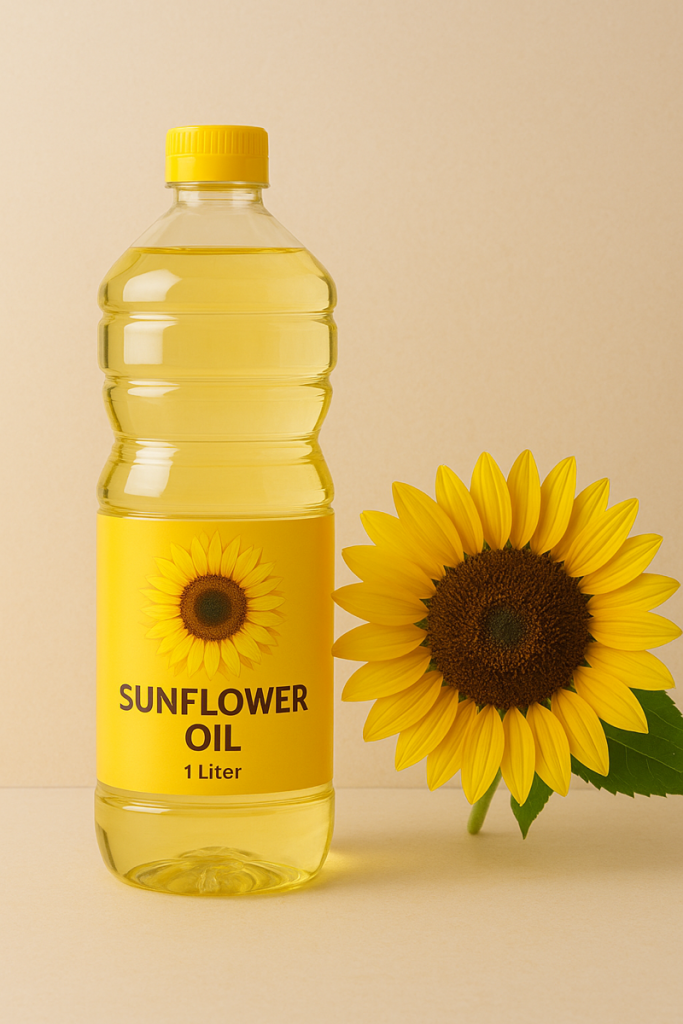
Whatever the sales pitch sounds like, ask for the numbers. Here’s what we quote on our standard refined, bleached, deodorized grade, and what any sunflower oil supplier Thailand worth working with should be able to match or explain a difference from:
- Type: refined, bleached, deodorized (RBD) sunflower oil, standard all-purpose grade
- Free fatty acid (FFA): 0.1% maximum
- Moisture and impurities: 0.1% maximum
- Color (Lovibond 5.25 inch cell): 2.0 to 3.0 Red maximum
- Peroxide value: 2.0 meq O2/kg maximum
- Smoke point: approximately 230°C
- Packaging: 1L, 2L, 5L bottles, 20L jerry cans, 200L steel drums, flexitank or ISO tank for bulk
- Shelf life: 12 months from production date, sealed and stored cool and dark
We also process crude, deodorized, high oleic, and organic grades, each with its own spec profile, and we’ve written a fuller comparison of refined versus crude sunflower oil elsewhere on the site if you want to go deeper on picking the right grade for your application.
How to Verify a Sunflower Oil Supplier Thailand Is Legitimate
Anyone can register a domain and put up a product catalog. Verifying that a sunflower oil supplier Thailand actually operates a facility here takes a bit more digging, but it’s worth the time before you send a deposit.
Ask for the company’s Thai business registration details and, where relevant, its Thai FDA (Food and Drug Administration) food product registration number, since food-grade oil manufactured or packed in Thailand for export generally needs to clear Thai FDA requirements. Ask whether they hold an export license through Thailand’s Department of Foreign Trade, and don’t be shy about asking for a factory address you could look up independently or request a video call from. A real sunflower oil supplier Thailand with an actual processing operation won’t have a problem confirming any of this, while a pure trading intermediary posing as a manufacturer often gets vague fast when the questions get specific.
Third-party inspection is the other piece worth insisting on, particularly for a first order. SGS, Bureau Veritas, and Intertek all operate in Thailand and can verify that what’s loaded into the container actually matches the certificate of analysis you were sent. It costs a few hundred dollars against a shipment worth tens of thousands, and it’s cheap insurance against a supplier who’s better at writing emails than running a refinery.
Free Trade Agreements That Can Work in Your Favor
One thing buyers sourcing from a sunflower oil supplier Thailand sometimes miss is that Thailand’s membership in ASEAN comes with a network of free trade agreements that can meaningfully affect your landed cost, depending on your destination country. Thailand, as an ASEAN member, benefits from preferential tariff arrangements with China, Japan, Australia and New Zealand, South Korea, and India through ASEAN’s various free trade areas, and the ASEAN portal on free trade agreements with dialogue partners lays out which agreements cover which countries.
Whether your shipment actually qualifies for preferential tariff treatment depends on rules of origin requirements that get technical fast, so this isn’t something to assume without checking, but it’s worth raising with your supplier and your own customs broker before you finalize an order. A sunflower oil supplier Thailand who’s shipped to your destination market before should be able to tell you whether a certificate of origin under one of these agreements applies to your shipment.
Shipping Out of Thailand: Ports, Transit Times, and What to Expect
Most bulk sunflower oil moving out of Thailand ships through Laem Chabang, the country’s main deep-sea container port in Chonburi province, though some shipments route through Bangkok Port depending on the buyer’s freight forwarder and destination. Laem Chabang handles the volume and has the terminal infrastructure, including the kind of tank cleaning and flexitank handling capability that general cargo ports don’t always have, which matters when you’re shipping liquid bulk rather than boxes. DP World’s own page on its Laem Chabang terminal operations gives a sense of the scale and certification standards involved.
Transit times from Thailand vary a lot by destination, shipments to nearby Southeast Asian ports can arrive in under two weeks, while a shipment to West Africa or South America might take four to six weeks depending on routing and transshipment. A sunflower oil supplier Thailand who’s shipped to your region before should be able to give you a realistic estimate rather than a generic “a few weeks” that doesn’t account for your actual port.
What Happens If a Shipment Doesn’t Match the Certificate of Analysis
It’s worth thinking through this scenario before it happens rather than after. If a shipment arrives and independent testing shows it doesn’t match the certificate of analysis you were sent, your first move should be documenting the discrepancy properly, retained samples, lab results, photos of the packaging and seals, before the product gets mixed into your own inventory or processing line.
Go back to your sunflower oil supplier Thailand with the specific test results rather than a general complaint, and reference the original certificate directly. A supplier acting in good faith will work with you on a resolution, whether that’s a partial credit, a replacement shipment, or an adjustment on the next order. One who stalls or gets defensive when shown independent lab results is telling you something about how the rest of the relationship would have gone anyway. This is also the strongest argument for using third-party inspection before the container even leaves Thailand, since catching a problem before shipment is far cheaper than resolving one after.
Documentation You Should Receive With Every Shipment
At minimum, expect a commercial invoice, packing list, certificate of origin, certificate of analysis specific to the batch you’re buying, and a bill of lading. Depending on your destination, you may also need a phytosanitary certificate, health certificate, or halal or kosher certification if your market requires it. A sunflower oil supplier Thailand handling regular export volume should have these processes down to a routine rather than scrambling to figure out what’s needed each time a new buyer asks.
Get the certificate of analysis before the shipment leaves, not after it arrives, so you have time to flag a problem while there’s still something that can be done about it. A supplier who’s slow to produce documentation before shipping is usually slower still once there’s an actual dispute to resolve.
Red Flags When Evaluating a Sunflower Oil Supplier Thailand
A few patterns are worth watching for. A quoted price that’s noticeably below the going market rate for the grade you’re asking about, with no clear explanation, usually means either the spec doesn’t match what you think you’re buying or the supplier is planning to substitute something cheaper once the deposit clears. Reluctance to name a physical factory address or arrange a video call is another one, since a company genuinely operating a processing facility in Thailand has no reason to keep that vague.
Watch for suppliers who push hard for full payment upfront on a first order, especially combined with vague answers about origin or specifications. Standard terms for a new buyer are usually a partial deposit with the balance against shipping documents, and a supplier demanding the opposite on a first transaction is asking you to carry all the risk. None of these signs alone proves a problem, but a sunflower oil supplier Thailand showing two or three of them at once is worth walking away from.
Requesting a Sample Before You Commit to a Full Container
A sample shipment is the cheapest verification tool available, and a legitimate sunflower oil supplier Thailand should have no problem sending one. It costs more per liter than a bulk order, obviously, since you’re not getting bulk pricing on a small volume, but it lets you run your own tests, or send it to a third-party lab, before you’re committed to a 20-metric-ton flexitank.
Ask that the sample come from the same production line and grade you’d actually be ordering, not a specially prepared batch that doesn’t represent what ships in bulk. Some buyers skip this step to save a couple of weeks, then find out the hard way that the bulk shipment doesn’t match what they expected. A few weeks spent testing a sample is cheap against the cost of a container that fails your own quality checks after it’s already at your port.
Seasonal Pricing and Timing Your Order
Sunflower oil pricing tracks the broader vegetable oil market, which moves with crude oil prices, weather conditions in the major growing regions, and how the current harvest is shaping up in whichever hemisphere is in season. A sunflower oil supplier Thailand quoting you a price today isn’t quoting a fixed number, it’s a snapshot of a market that can shift meaningfully within a few weeks.
If your order isn’t time-sensitive, it’s worth asking your supplier whether current pricing reflects a seasonal high or low, since locking in a large order right before a seasonal price drop costs real money. A supplier who tracks the market closely enough to have an honest opinion on timing is generally a better sign than one who just quotes whatever number keeps the conversation moving.
Packaging and Order Sizes
We pack in 1L, 2L, and 5L bottles, 20L jerry cans, 200L steel drums, and flexitank or ISO tank for full container loads, and the economics improve substantially once you’re ordering by the container rather than smaller formats. A 20-foot flexitank typically moves somewhere between 20,000 and 24,000 liters in a single shipment. We’ve written a more detailed breakdown of packaging formats and order sizing for bulk buyers if you want the fuller version, since covering it in full here would mean repeating ground we’ve already gone over elsewhere on the site.
Why We’re a Sunflower Oil Supplier Worth Working With in Thailand
We process refined, crude, deodorized, high oleic, and organic sunflower oil out of our Thailand facility, and we send a certificate of analysis with every shipment showing the actual batch results, not a reused generic spec sheet. Our Sunflower Oil for sale page has the full grade breakdown and specifications if you want to compare against what another sunflower oil supplier Thailand is quoting you.
If you’re still deciding between grades, our guide on refined versus crude sunflower oil walks through which one actually fits your use case, and our broader piece on sourcing bulk sunflower oil covers packaging, pricing, and quality control in more depth than we’ve repeated here.
Minimum order depends on packaging format, bottled and drummed orders can be smaller, while flexitank and ISO tank pricing is built around full container loads. Send us your target volume, grade, and destination port through our contact page and we’ll turn around a quote that reflects current market pricing rather than a stale price list.
A Quick Vetting Checklist
Before committing a deposit to any sunflower oil supplier Thailand, run through this. Confirm the actual factory address and ask for a video call if you can’t visit in person. Ask for Thai FDA registration and export license details. Request a certificate of analysis specific to your batch, not a generic template. Ask where the crude oil or seed actually originates. Confirm whether third-party inspection is welcome or resisted. Get payment terms in writing before you send anything, and be wary of full payment demanded upfront on a first order. None of this takes long, and a supplier who answers cleanly is telling you something more useful than any price quote on its own.
Frequently Asked Questions
Is sunflower oil actually grown in Thailand?
No. Thailand isn’t a sunflower-growing region, the crop doesn’t suit the climate here the way rice and sugar do. A sunflower oil supplier Thailand is processing, refining, and exporting oil made from seed or crude sourced from actual growing regions elsewhere.
What documents should a legitimate sunflower oil supplier Thailand provide?
At minimum, a commercial invoice, packing list, certificate of origin, batch-specific certificate of analysis, and bill of lading. Depending on your destination you may also need phytosanitary, health, halal, or kosher certification.
Which port does sunflower oil typically ship from in Thailand?
Most bulk shipments move through Laem Chabang, Thailand’s main deep-sea container port, though some route through Bangkok Port depending on the freight forwarder and destination.
How can I verify a sunflower oil supplier Thailand is a real processor and not just a trading intermediary?
Ask for a specific factory address, Thai FDA registration, and export license details, and request a video call if an in-person visit isn’t practical. Third-party inspection through SGS, Bureau Veritas, or Intertek adds another layer of verification, particularly on a first order.
Do free trade agreements affect the cost of buying from a sunflower oil supplier Thailand?
Potentially, depending on your destination country. Thailand’s ASEAN membership comes with preferential tariff arrangements with several major trading partners, though whether a specific shipment qualifies depends on rules of origin requirements worth confirming with your customs broker.
Should I request a sample before placing a bulk order?
Yes, and a legitimate supplier will send one without pushback. Ask that it come from the same production line and grade you’d actually order, so it reflects what a bulk shipment would look like rather than a specially prepared batch.
What’s a reasonable minimum order quantity from a sunflower oil supplier Thailand?
It depends heavily on packaging. Bottled or drummed orders can be relatively small, while flexitank and ISO tank pricing is generally structured around full container loads, so ask your supplier for a specific number once you know your packaging preference.
Finding a sunflower oil supplier Thailand isn’t the hard part, a search engine will hand you a dozen names in seconds. Finding one that actually operates a processing facility here, holds the right registrations, and will still be picking up the phone after your third or fourth order is what takes the actual work. Ask for the factory address, ask for the registration numbers, ask for a batch-specific certificate of analysis, and treat a supplier’s willingness to answer those questions as more telling than anything in their sales copy. Do that, and the oil that lands at your port will match what you were quoted, shipment after shipment.
Need certified organic product specifically? Our guide to being an organic sunflower oil supplier covers the certifications to check for and how to verify them before you order.
If your formulation specifically needs a flavor-neutral grade, our dedicated guide to choosing a deodorized sunflower oil supplier covers the FFA, peroxide value, and processing details that matter most for that specific use case.