
The Thai jasmine rice new crop season runs from planting in the monsoon months to harvest in November and December, with fresh new crop rice reaching export buyers from around December onward. If you buy Thai Hom Mali, this calendar matters. It affects the aroma in the bag, how the rice cooks, how much it costs and how easy it is to book. We’re DThai Company Limited, a Thai rice exporter, and we sell new crop and old crop Thai Hom Mali and fragrant rice to importers worldwide. Here’s how the season works, month by month, and how to plan your orders around it.
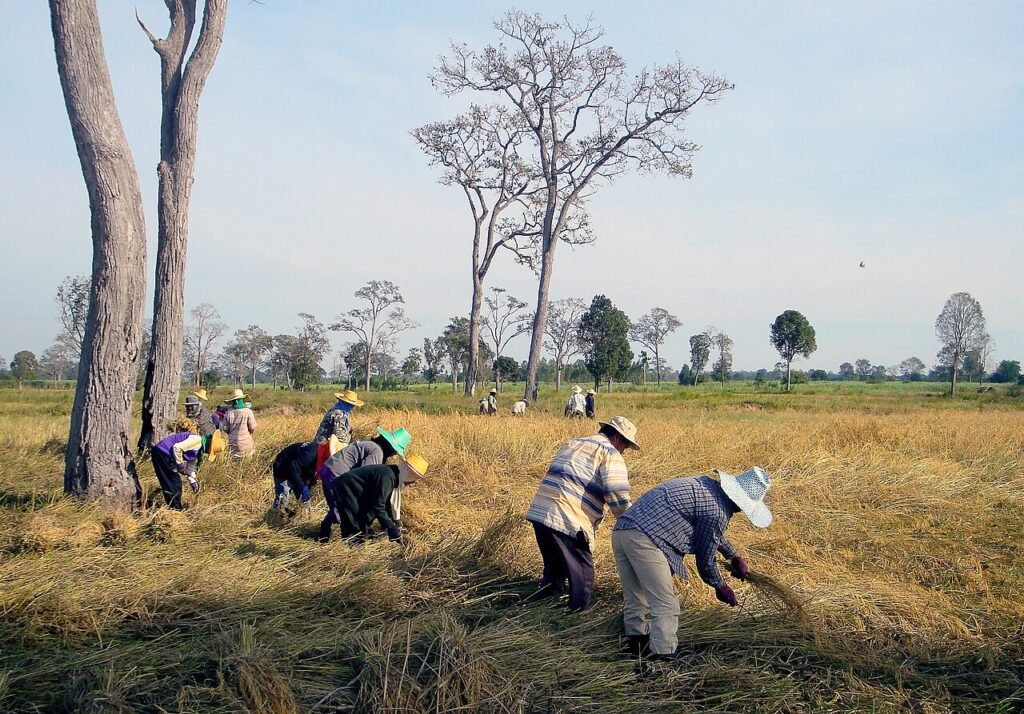
Table of Contents
Thai Jasmine Rice New Crop Season at a Glance
| Months | What happens | What it means for buyers |
|---|---|---|
| May to August | Rains arrive, farmers plant Hom Mali in the northeast | Watch the rainfall. Drought or flood here shapes the crop. |
| September to October | Rice grows and flowers as the days shorten | Early crop forecasts. Good time to plan your new crop orders. |
| November to December | Main harvest across the northeast | Paddy prices set for the season. Mills start buying. |
| December to February | New crop milled and exported | Strongest aroma of the year. New crop Hom Mali ships. |
| March to October | Same crop sold through the year, ageing in storage | Rice firms up and aroma slowly fades. Prices follow supply. |
That’s the whole Thai jasmine rice new crop season in one table. The details below explain why it works this way and how to use it.
Why Thai Hom Mali Has Only One Crop a Year
Thai Hom Mali rice comes mainly from two varieties, KDML105 and RD15. Both are photoperiod sensitive. That means they flower when the days get shorter, not after a fixed number of days. In Thailand that happens in October, whatever date the farmer planted. So no matter how early or late the rice goes in, it heads for harvest in November and December.
The result is one main crop per year. Farmers in the northeast plant in the rainy season, mostly between May and August, and harvest once the rain stops and the nights turn cool. That single harvest is the heart of the Thai jasmine rice new crop season.
Other Thai rice is different. White rice and Pathum Thani fragrant rice, grown mostly in the central plains with irrigation, can be planted two or even three times a year. There’s a main crop and a second, off-season crop harvested roughly from February to May. Hom Mali doesn’t work that way.
Where the Crop Grows
Most Thai Hom Mali comes from the northeast, the region called Isan. Key provinces include Roi Et, Surin, Si Sa Ket, Yasothon, Ubon Ratchathani, Buriram and Maha Sarakham. The best known area is Thung Kula Rong Hai, a wide dry plain with sandy, slightly salty soil.
Most of this rice is rain-fed. There’s very little irrigation, which is why the Thai jasmine rice new crop season depends so heavily on the monsoon. A late or weak rainy season can cut the crop. Heavy floods can do the same. The cool, dry weather at harvest is what builds the aroma, so a good finish to the season usually means a fragrant crop.
Some Hom Mali is also grown in the north, in provinces like Chiang Rai and Phayao, on a similar calendar.
Month by Month Through the Season
May to August: planting
The first heavy rains come in May or June. Farmers prepare the fields, then transplant seedlings or broadcast seed. Planting carries on into August, depending on when the rain arrives in each area.
For buyers, this is the time to keep an eye on weather news, because the start of the Thai jasmine rice new crop season sets the tone for the whole year. Reports of drought or late rain in the northeast are the first sign that the Thai jasmine rice new crop season might be short.
September to October: growth and flowering
The rice grows through the wet months and flowers in October. By now the trade starts to talk about likely volumes and prices. Exporters begin quoting new crop rice for shipment from December or January. This is the best point in the Thai jasmine rice new crop season to plan and reserve.
November to December: harvest
Harvest moves across the northeast in November and December. Farmers sell paddy to mills and collectors, and the paddy price for the year starts to settle. Fresh paddy is dried to safe moisture before storage and milling. This is the busiest stretch of the Thai jasmine rice new crop season.
December to February: new crop exports
New crop milled rice starts shipping in December and builds through January and February. This is when Thai Hom Mali smells its strongest, and it’s the part of the Thai jasmine rice new crop season most buyers care about. Many importers time their biggest orders of the year here, especially ahead of Lunar New Year and Ramadan when rice demand jumps in many markets.
March to October: the rest of the year
Mills and exporters hold paddy and milled rice in storage and sell it through the year. The rice is still the same crop, but it ages. By the second half of the year, buyers are looking at old crop rice until the next Thai jasmine rice new crop season brings fresh supply.
New Crop vs Old Crop: What Changes
Rice keeps changing after harvest. That’s the real reason the Thai jasmine rice new crop season matters to buyers.
| New crop (first few months) | Old crop (6 months or more) | |
|---|---|---|
| Aroma | Strongest | Lighter, fades slowly |
| Texture when cooked | Very soft, a bit sticky | Firmer, grains more separate |
| Water needed | Less | More |
| Moisture | Slightly higher | Lower, more stable |
| Who prefers it | Retail, Thai and Chinese customers, premium restaurants | Some food service and fried rice kitchens |
| Typical price | Often a premium early in the season | Depends on stocks left |
New crop isn’t always better for every use. Some kitchens actually prefer rice that’s a few months old, because it cooks firmer and doesn’t clump. Fried rice is the classic example. But for retail and for anyone selling on fragrance, fresh rice from the Thai jasmine rice new crop season is what customers want.
Cooking New Crop Rice
New crop Hom Mali has more moisture in the grain, so it needs less water. If your customers cook new crop with their usual water, they’ll get soft, wet rice and think the quality has dropped. A simple tip on your packs or to your restaurant customers helps a lot:
- New crop: about 1 cup of rice to 1 cup of water, maybe a little less.
- Old crop: about 1 cup of rice to 1.25 to 1.5 cups of water.
- Rinse once or twice only, to keep the aroma.
- Rest the rice with the lid on for 10 minutes after cooking.
We pass these notes to our buyers at the start of every Thai jasmine rice new crop season, because cooking complaints are one of the most common new crop questions we get.
How the Thai Jasmine Rice New Crop Season Moves Prices
Prices for Thai Hom Mali usually follow the harvest. A few patterns come up most years:
- Before harvest: old crop stocks run low. If the new crop looks weak, prices can firm up in September and October.
- At harvest: a big wave of paddy hits the market in November and December. In a good year, prices often ease.
- After harvest: prices settle and then move with export demand, the baht exchange rate, competing origins and government policy.
Weather is the wild card. A good monsoon means a big crop and softer prices. Drought or flood can push them up fast. Price news in the Thai press in 2025 and 2026 showed how quickly Hom Mali paddy prices can swing within a single Thai jasmine rice new crop season. Ask for a current quote rather than relying on last year’s figures. Our wholesale jasmine rice guide covers how pricing works in more detail.
Planning Orders Around the Thai Jasmine Rice New Crop Season
Here’s how we suggest buyers use the Thai jasmine rice new crop season:
- Talk to your supplier in September or October. Get an early view of crop size and pricing, and reserve volume for new crop shipments.
- Book your first new crop shipment for December or January. That gets fresh rice onto your shelves early, often ahead of competitors.
- Plan for holiday peaks. If you sell more rice at Lunar New Year, Ramadan or year-end holidays, work back from those dates.
- Spread shipments through the year. Rather than buying a huge stock at harvest, ship every month or two so your stock stays fresh.
- Ask for the crop year on every contract. “Crop 2025/26” written on the contract and on the bags removes any doubt.
- Consider a supply contract. Fixing volume for the year protects you from shortages if the crop is small.
Our supply contracts are built for exactly this kind of planning.
Good Seasons and Bad Seasons
No two years are the same. Here’s what tends to separate a strong Thai jasmine rice new crop season from a weak one:
- Rain timing. Rain that arrives on time in May and June lets farmers plant early and evenly. A late start squeezes the season.
- Rain amount. Too little and the rain-fed fields of the northeast suffer. Too much and low-lying fields flood just as the crop matures.
- Harvest weather. Cool, dry nights in November build aroma and let farmers dry paddy properly. Late rain at harvest can damage grain and raise moisture.
- Pests and disease. Brown planthopper and blast disease can hit yields in some years.
- Farmer choices. If prices were low the year before, some farmers switch area to other crops or other rice varieties.
A strong season usually means plenty of rice, good aroma and softer prices. A weak one means tighter supply, firmer prices and sometimes more variable quality. We keep our buyers updated through each Thai jasmine rice new crop season so nobody is surprised.
Timing Your Shipments Around Holidays
Demand for rice jumps before big holidays in many markets. In early 2027, Lunar New Year and the start of Ramadan both fall in the first half of February, right in the middle of the new crop shipping window. That’s a lot of demand landing at the same time.
If you want new crop Hom Mali on your shelves for those weeks, work backward:
- Allow transit time to your port, from a few days within Asia to four to six weeks to Africa, Europe or the Americas.
- Allow a week or two for customs clearance and distribution.
- Allow two to three weeks for milling, packing and loading.
For long routes, that means confirming your order by November at the latest. The Thai jasmine rice new crop season is short, and the best lots get booked early.
From Harvest to Your Port
It helps to picture the path your rice takes during the Thai jasmine rice new crop season:
- Farmers harvest and sell paddy to mills or collectors.
- Paddy is dried to a safe moisture and stored.
- Mills husk, polish, grade and sort the rice when an order comes in.
- The rice is tested, packed in your chosen bags and labelled with the crop year.
- It’s loaded into containers, fumigated and inspected.
- The container sails from Bangkok or Laem Chabang to your port.
From the first harvest in November, the earliest new crop containers usually leave Thailand in December. For most buyers, the bulk of new crop arrivals land between January and March.
Questions to Ask Your Supplier About the New Crop
- How does this year’s crop look compared with last year?
- When will you have new crop milled rice ready to ship?
- Will the crop year be stated on the contract and the bags?
- Can I reserve volume now at an agreed price or pricing basis?
- Can you send a new crop sample before I confirm?
- What happens if the crop is short?
A supplier who answers these clearly during the Thai jasmine rice new crop season is one you can plan with.
How to Tell If Rice Is Really New Crop
Some sellers label old rice as new crop to get a better price, especially early in the Thai jasmine rice new crop season when new crop earns a premium. A few checks help:
- Smell the raw rice. Fresh Hom Mali has a light scent even uncooked.
- Cook a sample with less water. New crop cooks soft with a little water. Old crop needs more.
- Check the dates. Milling date and crop year should be on the bag and the certificate.
- Ask for a lab test. Labs can test for freshness and, for big orders, run DNA purity tests at the same time.
- Use independent inspection. An inspector at loading can confirm crop details and quality before the rice leaves Thailand.
We go into blending and labelling fraud in more depth in how to spot genuine Hom Mali rice.
New Crop for Retail and Private Label Buyers
If you sell your own brand of rice, the Thai jasmine rice new crop season is a marketing chance as well as a supply question. Many shoppers in Asia and in Asian grocery stores abroad look for “new crop” on the pack, and some brands print the crop year in large type for exactly that reason.
To make the most of it:
- Get your artwork and bag printing done before harvest, so you’re ready to pack as soon as new crop is milled.
- Print the crop year clearly on the front of the bag.
- Use vacuum packs or lined bags to keep the new crop aroma for longer on the shelf.
- Plan smaller, more frequent shipments so your shelves stay fresh right through the year.
We handle printing and packing in Thailand for private label buyers. Read how in our private label rice supplier guide. Planning your packs before the Thai jasmine rice new crop season starts is the easiest way to be first on the shelf with fresh rice.
Storage: Keeping New Crop Fresh Longer
Once your new crop rice lands, how you store it decides how long that aroma lasts. Heat is the main enemy. Rice stored above 30°C loses fragrance much faster. Keep it cool, dry, off the floor and away from strong smells. PE-lined bags or vacuum packs hold the aroma longest. See our guide to rice packaging for export for the options.
Even with good storage, plan to sell rice from each Thai jasmine rice new crop season within six to nine months for the best aroma. That’s another reason to spread your orders through the year rather than buying all at once.
Other Thai Rice and Their Seasons
Not every Thai rice follows the same calendar:
- Thai Hom Mali rice: one main crop, harvest November to December.
- Thai fragrant rice (Pathum Thani): two or more crops a year, so fresh supply comes more often.
- Thai white rice: main crop and off-season crop, harvested at several points in the year.
- Thai glutinous rice: mostly a main-season crop from the north and northeast, similar timing to Hom Mali.
- Parboiled rice: made from white paddy, available all year.
If you need fragrant rice outside the Hom Mali new crop window, Thai fragrant rice can fill the gap with fresher stock. For a full overview of Thai grades, see types of Thai rice for export.
Our New Crop Thai Hom Mali Specifications
| Parameter | Thai Hom Mali 100% new crop |
|---|---|
| Varieties | KDML105, RD15 |
| Origin | Northeast Thailand |
| Hom Mali purity | 92% min, government certified |
| Broken (max) | 4 to 5% |
| Moisture (max) | 14% |
| Average grain length | 7.0mm min |
| Chalky kernels (max) | 6% |
| Foreign matter (max) | 0.1% |
| Crop year | Stated on contract and bags |
| Milling | Milled to order |
| Packing | 1kg to 10kg retail, 25kg and 50kg PP bags with PE liner, vacuum packs, private label |
| Load per 20ft | About 25 MT in 25kg or 50kg bags |
| Loading ports | Bangkok or Laem Chabang |
The certification behind these figures is explained in TAS 4000 Hom Mali rice.
Keeping Track of the Crop
If you want to follow crop conditions yourself, the FAO GIEWS country brief for Thailand gives regular updates on rice planting, harvest and production. For background on the variety itself, the jasmine rice page on Wikipedia is a good start. We also share crop news with our buyers through each Thai jasmine rice new crop season, so you hear about weather problems early.
Why Buy New Crop Hom Mali From DThai
- We state the crop year on every contract and every bag.
- We mill to order, so your rice is fresh when it ships.
- We let you reserve new crop volume before harvest.
- We welcome independent inspection and DNA testing.
- We give you honest crop updates, good or bad.
We also supply sugar and sunflower oil if you want to combine products. More about us on our why choose us page.
Frequently Asked Questions
When is the Thai jasmine rice new crop season?
Planting runs from about May to August, harvest is in November and December, and new crop rice ships from around December to February.
Why does Thai Hom Mali have only one crop a year?
The varieties are photoperiod sensitive. They flower when the days shorten in October, so they can only be harvested once a year.
Is new crop jasmine rice better?
Rice from the Thai jasmine rice new crop season has the strongest aroma and softest texture. Some kitchens prefer slightly older rice because it cooks firmer. It depends on how your customers use it.
How long does new crop aroma last?
With cool storage and good packing, the aroma is at its best for six to nine months after milling.
When should I order new crop Hom Mali?
Start talking to your supplier in September or October, and book your first shipment for December or January.
Do you ship new crop rice worldwide?
Yes. We ship to Asia, the Middle East, Africa, Europe, the Americas and Oceania. See our worldwide shipping page.
The Thai jasmine rice new crop season gives you the freshest, most fragrant Hom Mali of the year, if you plan for it. Reserve early, ship in steady lots, and get the crop year in writing. Contact us to reserve new crop volume or get a quote for your next shipment. You can also see all our grades on the rice for sale page.